The night you almost did not meet
A missed train. A friend who insisted. One more drink, one ordinary hello. Some beginnings only look inevitable when you look back.
A declaration, or just two familiar words
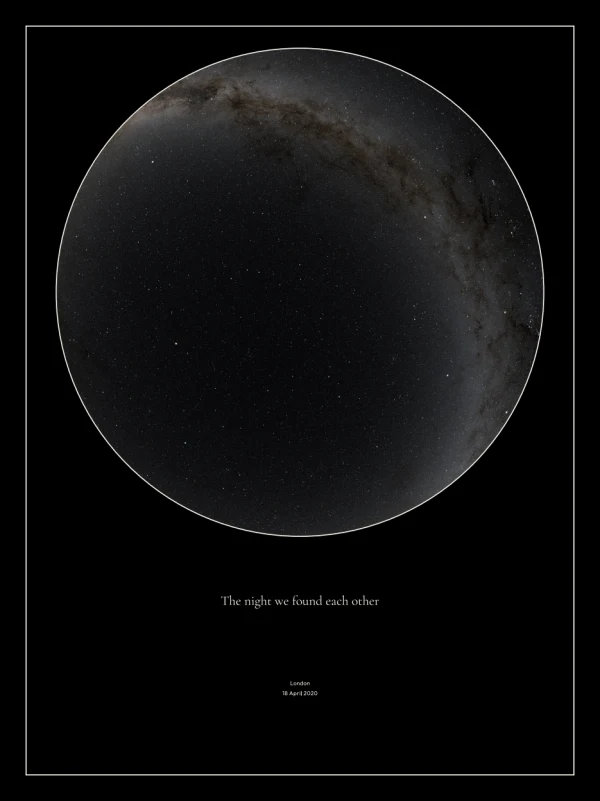
A beginning with a story
London · 18 April 2020 · 22:15 local
“The night we found each other”
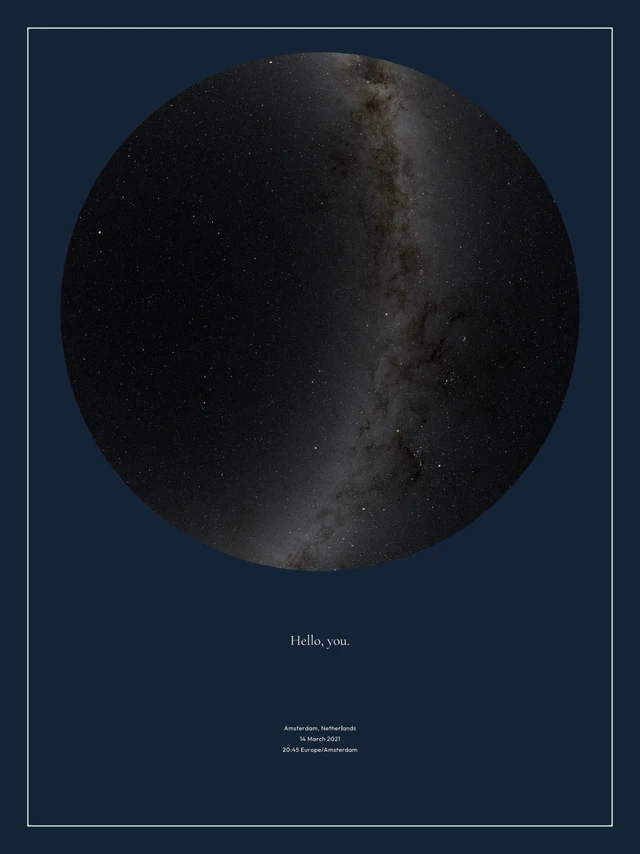
A quieter first hello
Amsterdam · 14 March 2021 · 20:45 local
“Hello, you.”
Sky-source attribution: HYG · CC BY-SA 4.0. Deep sky: NASA/Goddard Scientific Visualization Studio; Gaia DR2: ESA/Gaia/DPAC. Constellation figures: IAU and Sky & Telescope (Roger Sinnott & Rick Fienberg); Alan MacRobert; D3 modifications by Olaf Frohn; CC BY 4.0, modified. Fictional reference artwork.
These wholly fictional London and Amsterdam first-meeting examples use their own calculated places and times. One dedication tells a story; the other simply says “Hello, you.” Neither is a real couple’s testimonial.
The first hello or the first date?
The first hello
Use the moment when you first crossed paths if the chance of it still means something. It may have happened before either of you understood it as a beginning. Agree on the actual place and day rather than tidying the memory into a more cinematic story.
The first date
Use the evening you deliberately chose each other’s company if that feels like the real start. A café, park or station can matter more than an impressive destination. The invitation time is only a starting clue, not proof of the moment you want to keep.
Reconstruct a memory without inventing precision
Start with what you both recognise
Check a shared diary or an old message together if you want to. The aim is to agree on the memory, not to collect private records from someone else or turn uncertain recollections into a dispute.
Notice midnight and travel
An evening may have become the next calendar day. Use the local date and timezone of the actual meeting place, especially if one of you was travelling. Your home timezone is not necessarily the venue’s.
Let approximate stay approximate
If you remember only “after dinner”, compare a few real times in the sky explorer. If there is no reliable time, keep the explicit unknown-time choice and review its assumption. A precise-looking minute can otherwise suggest knowledge you do not have.
City, venue, or the name only you use
| Printed label | What it can add | What it must not change by accident |
|---|---|---|
| The city | A simple anchor that guests can understand. | The actual coordinates should still match the chosen place. |
| The café or venue | A familiar detail without a long dedication. | Do not publish an exact private home address just to make a label more specific. |
| Your own nickname | A phrase such as “Our corner of the world”. | It changes the words, not the observation point or the calculated sky. |
A dedication can be an inside joke
A plain sentence can carry an entire evening. Original starting lines: “Hello, you.” “Glad we stayed a little longer.” “The ordinary night that changed everything.” An inside joke is welcome if both of you enjoy seeing it. Keep the longer version in a separate note so the printed line can breathe. Text on a physical poster can be read by visitors or in photographs; leave out words you would rather keep between you.
What if it happened in daylight?
A daytime meeting still has a real celestial calculation. The Deep sky reconstruction shows an ideal dark sky for that instant, without sunlight, weather or buildings; it is not a photo of the scene as you saw it. You can remember the real meeting time without pretending the meeting happened at night. A dedication such as “The day we found each other” may fit better than forcing a nighttime phrase.
Bring it to an anniversary, quietly
The first-meeting date can differ from the date you celebrate now. A note can connect them: why this beginning still matters after the years in between. If you have already given a wedding sky, this offers a different story rather than the same poster with a new number. Choose a size that fits your shared home and leave time for actual proof and delivery review.
The beginning, as you remember it
What if our first meeting was during the day?
Use that actual moment if it matters to you. The poster is a calculated ideal-dark-sky representation, not the visible daylight scene. You can change the dedication to say day rather than night.
Link to this answer: What if our first meeting was during the day?Can the dedication stay private?
Designing does not require a public page, account or email. Printed words will still be visible to anyone who sees the poster, so keep a very private message in a separate note or leave it off the design.
Link to this answer: Can the dedication stay private?What if we remember different first dates?
Choose together which beginning the gift should represent. A quiet shared choice is more useful than presenting one uncertain recollection as the official story.
Link to this answer: What if we remember different first dates?Start with the place you still remember
Explore the sky privately. Try a few words, then take your time with the finished proof.
Keep your first hello