Two ways to give your sky a voice
The moment can stay the same while the design changes completely. Choose the style you want to live with, rather than the one with the most detail.
The same Paris moment, in two styles
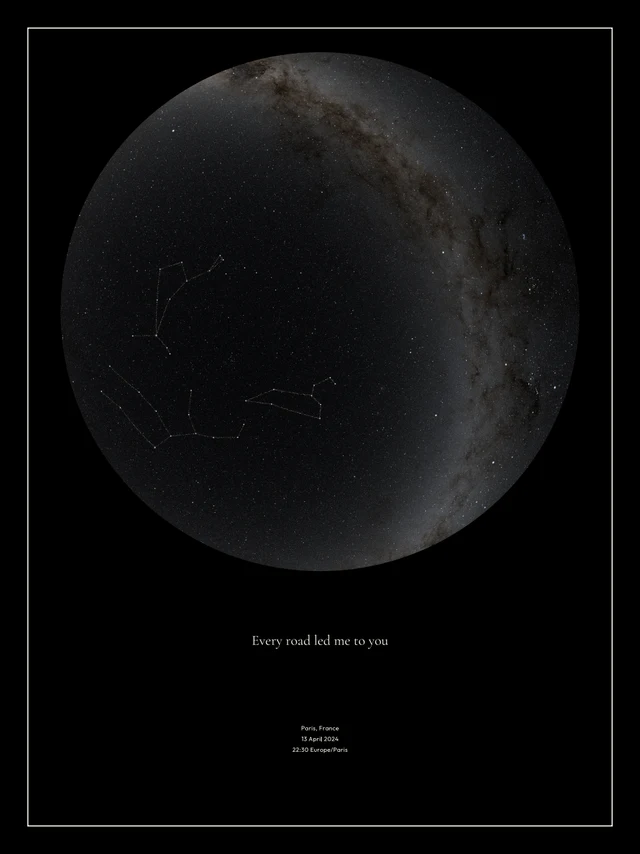
Deep sky
A textured ideal-dark-sky reconstruction
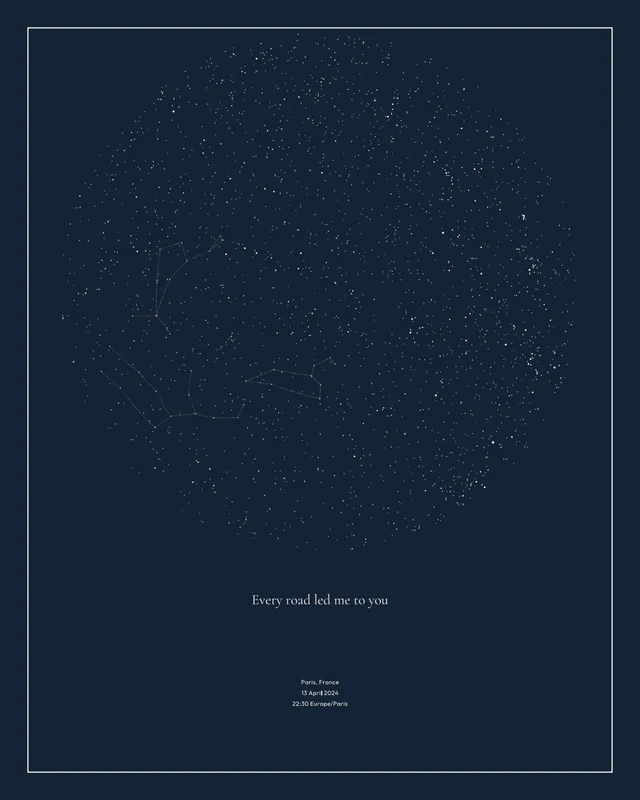
Celestial
A quieter catalogue-based star drawing
Sky-source attribution: HYG · CC BY-SA 4.0. Deep sky: NASA/Goddard Scientific Visualization Studio; Gaia DR2: ESA/Gaia/DPAC. Constellation figures: IAU and Sky & Telescope (Roger Sinnott & Rick Fienberg); Alan MacRobert; D3 modifications by Olaf Frohn; CC BY 4.0, modified. Fictional reference artwork.
These actual digital proofs use 13 April 2024 at 22:30 local time in Paris. They demonstrate composition, not physical paper colour or photographic observation.
Choose by what matters to you
| If you want… | Consider | Why |
|---|---|---|
| Milky Way texture and a dense night-sky feeling | Deep sky | Its projected catalogue-based texture creates an immersive background. |
| Clearer separation between points and words | Celestial | The simpler star drawing leaves more visual space around the dedication. |
| Just a few personal constellation accents | Either style | Select up to three figures and review them at the actual chosen moment. |
| A quiet ivory design | Try Celestial first | Compare the contrast in the finished proof; a screen cannot certify physical colour. |
What stays the same when you switch
The saved date, time, timezone and coordinates still identify your moment. Your words, layout and format remain choices to check. A style switch does not turn an unknown time into an exact one, or a daytime moment into a historical night exposure. Inspect the finished proof after any change that affects the composition.
What Deep sky can honestly show
The NASA/Goddard texture is an astronomical reconstruction projected into the local view. It brings atmosphere and the Milky Way, but not clouds, city glow, terrain or the original weather. Its source catalogue and processing differ from the calculated accent geometry; we do not promise exact individual-star registration for every small photographic detail.
What Celestial can honestly show
The point-based style directly expresses the calculated catalogue stars above the ideal horizon. Point sizes and constellation finishes are a visual treatment. The print is a personal chart, not a replacement for an observing atlas, and does not add mountains or atmospheric refraction to the horizon.
Let the accents do just enough
A quieter sky
Leave constellation detail off, or choose a small number of accents. Keep labels and grid off when your priority is the dedication and the overall shape of the sky.
A sky you can explore
Add selected figures or labels when you want an invitation to look closer. Use the optional grid only if its height-and-direction explanation is useful to you. Inspect the magnifier and the complete finished proof, not just a room mockup.
Compare the styles with your own words
Start a private draft and switch styles around the same moment. There is no need to order before deciding which feels right.
Find your design